




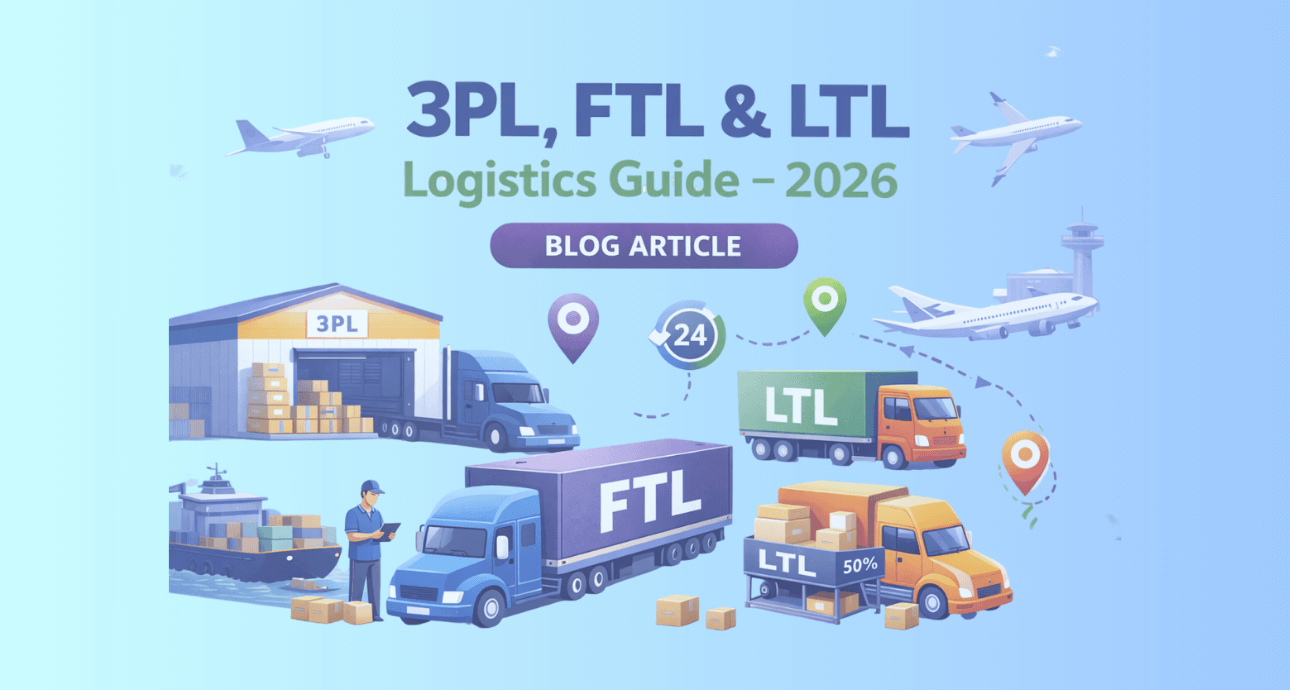
3PL, FTL & LTL Logistics Guide – 2026
The logistics industry has become the backbone of modern commerce. With rising customer expectations, same-day delivery trends, and increasing freight costs, businesses cannot rely on outdated or manual shipping workflows anymore. Today, companies must adopt scalable logistics models and smart automation to stay competitive.
This is where 3PL (Third-Party Logistics) partners, along with FTL (Full Truckload) and LTL (Less-Than-Truckload) shipping, play a major role. Combined with Odoo Automation, businesses can achieve higher efficiency, real-time visibility, and lower operational costs.
This detailed guide breaks down everything you need to know about 3PL, FTL, LTL, and how integrating them with Odoo can transform your supply chain into a smart, fully automated system.
What is 3PL (Third-Party Logistics)?
3PL refers to outsourcing logistics operations to specialized providers who manage warehousing, shipping, freight, and sometimes complete supply chain operations. Businesses of all sizes—from startups to enterprises—use 3PL to simplify operations and expand faster without heavy infrastructure investments.
Key Services Offered by 3PL Providers
- Warehousing & Storage: Safe stock management in multiple locations.
- Order Fulfillment: Pick, pack, label, and ship operations.
- Transportation Management: Route optimization, carrier management, and freight coordination.
- Inventory Management: Stock availability, reorder planning, and SKU tracking.
- Reverse Logistics: Handling returns, damaged goods, and replacements.
- Freight Billing & Documentation: Automated billing, proof-of-delivery, and reconciliation.
Modern 3PL partners go beyond storage—they serve as a strategic extension of your business.
Understanding FTL (Full Truckload)
Full Truckload shipping is ideal when one shipment occupies the entire truck. It is faster, safer, and highly efficient for large shipments.
When to Choose FTL?
- High-volume freight
- High-value or fragile items
- Time-sensitive deliveries
- Long-distance shipments
Advantages of FTL Shipping
- Faster transit due to no multiple stops
- Reduced risk of damage
- Lower handling and minimal delays
- Predictable delivery schedules
Understanding LTL (Less-Than-Truckload)
Less-Than-Truckload is perfect when your shipment does not require an entire truck. This shipping model combines multiple shipments from different customers into a single truck.
When to Choose LTL?
- Small or medium shipments
- Cost-sensitive shipments
- Regional or multi-location freight
- Regular recurring deliveries
Advantages of LTL Shipping
- Lower freight cost
- Flexible delivery schedules
- Ideal for scaling eCommerce and retail logistics
- Pallet-based shipping options
FTL vs LTL: Detailed Side-by-Side Comparison
| Feature | FTL (Full Truckload) | LTL (Less-Than-Truckload) |
| Truck Usage | Full truck devoted to one shipment | Shared truck with multiple customers |
| Transit Time | Faster, direct trip | Slower due to multiple stops |
| Cost | Higher fixed cost | Cheaper overall |
| Handling | Minimal | Multiple handling points |
| Damage Risk | Very low | Medium |
| Ideal For | Bulk, fragile, or urgent freight | SMEs, eCommerce, pallet shipments |
| Tracking | Simple | Multi-stage tracking |
Why Modern Businesses Use 3PL, FTL & LTL
Different industries rely on 3PL for different reasons. Below is a detailed industry-wise breakdown.
1. eCommerce & D2C Brands
The fastest-growing segment for 3PL usage.
Why They Use 3PL
- Fast fulfillment & same-day delivery
- Multi-warehouse optimization
- Easy returns management
Common Use Cases
- Pick, pack & ship
- Marketplace distribution (Amazon, Shopify, Magento)
- Seasonal demand scaling
2. Retail & Wholesale
Retailers require multi-store distribution and centralized replenishment.
Why They Use 3PL
- Faster replenishment cycles
- Efficient inventory balancing
- Reduced stockouts
Common Use Cases
- Store-to-store transfers
- Bulk shipments
- Reverse logistics
3. Distributors & B2B Suppliers
Distribution networks rely heavily on LTL for frequent, smaller shipments.
Why They Use LTL
- Lower cost per shipment
- Multiple delivery points
- Better route optimization
Typical Shipments
- Multi-drop deliveries
- Regional replenishment
4. Furniture & Home Décor
Large but not always full-truck shipments.
Why They Use LTL
- Palletized heavy goods
- Cost-effective freight
- Faster regional deliveries
Top 3PL Providers Across the World
🇨🇦 Canada
- Purolator Logistics
- Canada Post Logistics
- Kuehne + Nagel
- DB Schenker
- FedEx Supply Chain Canada
- UPS Supply Chain Solutions
- Ryder Logistics
🇺🇸 USA
| 3PL Provider | Specialization |
| C.H. Robinson ⭐ | FTL, LTL, Brokerage |
| XPO Logistics | Freight & distribution |
| FedEx Supply Chain | Last-mile & warehousing |
| UPS Supply Chain | Global distribution |
| FreightQuote (CH Robinson) | LTL rate marketplace |
| Coyote Logistics | Multi-modal services |
🇪🇺 Europe
- Palletways (Specialized pallet shipping)
- DHL Supply Chain
- DSV
- GEODIS
- Rhenus Logistics
- CEVA Logistics
- Bolloré Logistics
- GLS Freight
These providers dominate key markets with strong carrier networks and multi-modal delivery coverage.
Common Challenges Without ERP–3PL Integration
Businesses without Odoo + 3PL connectivity often face:
Operational Issues
- Manual shipment creation
- Multiple carrier portals
- Duplicate data entry
Visibility Issues
- No centralized tracking
- No automated status updates
Financial Errors
- Delay in freight billing
- Mismatched invoice amounts
High Delivery Errors
- Incorrect labels
- Missed delivery windows
This is why Odoo logistics automation has become essential.
How Odoo Integration Automates 3PL, FTL & LTL Logistics
Odoo, combined with powerful APIs, enables end-to-end logistics automation.
Key Features We Integrate
1. Automated Shipment Creation
- Sales Order → Delivery Order → Shipment
- Flexible support for FTL, LTL, pallet shipping
2. Real-Time Freight Quotes
- Compare prices from multiple carriers
- Auto-apply rules (markup, margin, discounts)
3. Label & BOL Generation
- PDF/ZPL label printing
- Bill of Lading creation
- Pallet documentation
4. Tracking & Status Sync
- Live shipment tracking
- Automatic status updates in Odoo
- Customer portal updates
5. Freight Bill & Invoice Sync
- Carrier invoices directly into Odoo
- Automated reconciliation
Before vs After Odoo Integration: Transformation Table
| Process | Before Integration | After Odoo Integration |
| Rate Check | Manual lookup | API-driven auto rate lookup |
| Shipment Booking | Carrier website | Auto-booking inside Odoo |
| Label Printing | Download manually | Auto label generation |
| Tracking | Manual entry | Real-time synced |
| Billing | Offline, delayed | Automated & accurate |
3PL Integrations Delivered by Vraja Technologies
We have implemented seamless Odoo integrations for global logistics players:
1. C.H. Robinson Integration
- FTL & LTL booking
- Rate API
- Tracking sync
- Freight invoice automation
2. FreightQuote (CH Robinson) Integration
- LTL rate shopping
- Carrier comparison
- Auto-shipment creation
3. Palletways Integration
- EU & UK pallet freight
- Consignment creation
- Label & tracking sync
Our integrations help businesses reduce logistics time, improve accuracy, and achieve automated workflows.
Conclusion
- Real-time freight transparency
- Faster fulfillment cycles
- Error-free operations
- Lower logistics costs
- End-to-end supply chain coordination
At Vraja Technologies, we specialize in building robust, scalable Odoo integrations for 3PL, freight, and pallet networks. Whether you need CH Robinson, Palletways, UPS, FedEx, or any custom 3PL integration — we can help you build a smart, automated logistics ecosystem.