




Sales
Order data, pricing, discounts
Odoo eCommerce integration connects an online store to Odoo's ERP system so product, order, and inventory data move between the two automatically; enter it once, and it shows up in both places, instead of re-keying the same order or stock update twice.
Vraja Technologies builds and supports these integrations, including connections to Shopify, BigCommerce, WooCommerce, online marketplaces, and shipping providers.
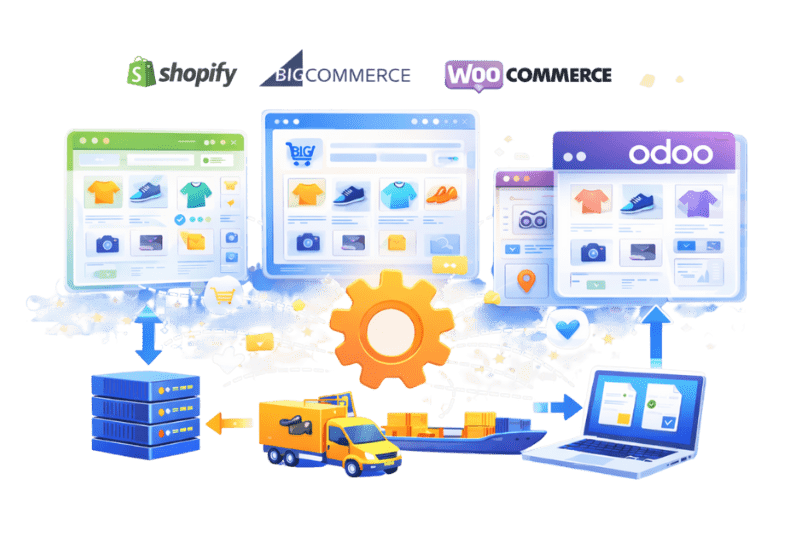
Odoo eCommerce integration links a storefront to Odoo's ERP system so that products, orders, customers, and inventory are shared between the two. The storefront can be Odoo's built-in eCommerce module or an external platform such as Shopify, BigCommerce, or WooCommerce, connected to Odoo through a dedicated integration.
These integrations usually run on APIs, webhooks, or a platform-specific connector module built to keep the two systems in sync.
Connector logic between your storefronts and Odoo ERP
Shopify, WooCommerce, and BigCommerce are standalone storefronts. To connect any of them to an ERP system, a business needs a separate integration, whether a connector module or custom API work, to keep inventory, orders, and accounting in sync between the two systems.
Odoo eCommerce is different because the storefront is a module inside Odoo itself. There's no second system to sync; inventory, sales, and accounting are already part of the same database as the storefront.
| Standalone Platforms (Shopify, WooCommerce, BigCommerce) | Odoo eCommerce | |
|---|---|---|
| Storefront and ERP | Separate systems, connected by an integration | Same system |
| Data sync | Requires a connector or API to keep data current | Not needed, data is shared by default |
| Best fit | Businesses already running one of these platforms who don't want to migrate | Businesses building a new store, or wanting the storefront and ERP fully unified from the start |
For a business already using Shopify, BigCommerce, or WooCommerce, an Odoo integration gets that same data connection without replacing the existing storefront, which is what the platform sections below cover.
An ecommerce platform integration works by connecting the storefront's data, such as orders, products, customers, and inventory, to Odoo using the platform's API or a connector. When an order is placed on the storefront, the connector sends that order to Odoo, where it can be processed for fulfillment, invoicing, and accounting.
The same connection works in the other direction: changes made in Odoo, such as updated stock levels or new product listings, are sent back to the storefront. Most integrations sync on a schedule or in real time, depending on how the connector is configured.
Orders, products, customers, and inventory originate or change in the ecommerce platform.
The platform API, connector, schedules, and webhooks move and validate data.
Odoo processes fulfillment, invoicing, accounting, sales, and inventory workflows.
Stock levels and other configured updates are sent back to the storefront.
An Odoo eCommerce setup relies on a small set of core modules rather than a long list of add-ons:
Order data, pricing, discounts
Stock levels, warehouse locations, product variants
Invoices, payments, tax records
Product catalog, descriptions, images (when using Odoo's own storefront)
Customer records and order history
Odoo e-commerce data integration typically covers four categories of data between the storefront and Odoo: products, orders, inventory, and customers.
Product details, pricing, variants, images
Order details, order status, payment status
Stock levels across one or more warehouses
Customer records and order history
Odoo is an ERP system with built-in modules for sales, inventory, accounting, and CRM. When an e-commerce platform is integrated with Odoo, storefront data becomes part of that same ERP system rather than sitting in a separate database.
This means an order placed on the storefront can move through Odoo's existing sales and inventory workflow: the order is recorded, stock is reserved, an invoice is generated in accounting, and the customer record is updated in CRM, without a separate system handling e-commerce data on its own.
Odoo eCommerce integrations run on two APIs working together, not one. Odoo provides its own APIs, including XML-RPC and JSON-RPC, that let external systems read and write data such as orders, products, and inventory directly. On the other side, the connector also uses the ecommerce platform's own API - Shopify's API for the Shopify connector, BigCommerce's API for the BigCommerce connector - to pull and push data on that platform.
This is the mechanism most Odoo ecommerce connectors use: Odoo's API handles the Odoo side, the platform's API handles the storefront side, and webhooks (where the platform supports them) push updates instantly instead of waiting for a scheduled sync.
Custom, API-based integration is used when a business needs a connection tailored to a specific workflow, a marketplace, or a platform without an existing off-the-shelf Odoo connector.
Shopify, BigCommerce, WooCommerce, marketplace, or another storefront API.
Connector logic, mapping, authentication, webhooks, scheduling, and workflow-specific rules.
Odoo-side read and write operations for orders, products, inventory, customers, and related records.
Connects a Shopify store to Odoo so that products, product variants, customers, orders, and inventory update automatically in both systems. Supports managing multiple Shopify stores from a single Odoo instance, with real-time webhook updates for new orders and customers.
Explore integrationConnects a BigCommerce store to Odoo so that products, customers, and orders update automatically in both systems. Supports managing multiple BigCommerce stores from a single Odoo instance, with real-time webhook sync for orders, order status, and product updates.
Explore integrationConnects a WordPress-based WooCommerce store to Odoo so that products, orders, customers, and inventory update automatically in both systems. Supports managing multiple WooCommerce stores from a single Odoo instance, with real-time webhook sync for orders, order status, products, and customers.
Explore integrationEach connector follows the same general setup pattern, though the specifics differ by platform:
Generate API credentials on the platform itself. Shopify and WooCommerce use a Consumer Key/Secret pair generated in the store's admin settings; BigCommerce uses a Client ID, Store Hash, and Access Token generated under Store-Level API Accounts.
Install the connector app in Odoo and create a store instance, entering those credentials.
Configure product, order, and tax settings specific to that platform; for example, BigCommerce lets you choose between "Create Separate Line" or "Odoo Default" for how taxes map into Odoo orders.
Set up webhooks for the real-time events each platform supports.
Import existing data, products, customers, and orders — either all at once or filtered by date range or ID.
Use the log management screen available on all three connectors to check and correct anything that fails during sync.
Once e-commerce order and customer data lives in Odoo, that data can feed directly into marketing platforms instead of being exported and re-uploaded by hand. Vraja builds and maintains Odoo integrations for four marketing platforms, plus two marketing tools built directly on top of Odoo data.
Syncs contacts, order history, and customer data from Odoo into ActiveCampaign for email automation and lead scoring
View integrationConnects Odoo to Brevo for email and SMS campaigns built on Odoo customer and order data
View integrationSyncs Odoo customer, order, and product data into Klaviyo for ecommerce email flows such as abandoned-cart and post-purchase sequences
View integrationSyncs Odoo contact and order data into Mailchimp audiences and lists for email campaigns
View integrationSegments Odoo customer data by recency, frequency, and monetary value to flag high-value and at-risk customers for targeted campaigns
View integrationSends automated SMS messages from Odoo, including order reminders and other triggered notifications
View integrationEach integration connects to a different platform's API, so we build and sell them as separate connectors rather than one bundled marketing module.
one record in Odoo instead of matching numbers across the storefront and the back office by hand.
an order placed on the storefront moves through fulfillment in Odoo without someone re-entering it
updates move between systems on their own, instead of someone exporting and re-uploading data.
an invoice is generated and financial records update as each order comes in, rather than after the fact.
All three connectors use webhooks to push certain events into Odoo instantly: new orders and customers on Shopify; orders, order status, and products on BigCommerce; orders, order status, products, and customers on WooCommerce, instead of waiting for the next scheduled sync
Each connector includes a log management screen that records where a process broke, so the specific failure can be found and corrected without re-running the entire import or export
All three connectors support multiple stores from a single Odoo instance
Handled directly during order import on all three connectors — Shopify additionally imports duties, and BigCommerce lets you choose how taxes map into Odoo (separate tax line vs. Odoo's default calculation)
Shopify and WooCommerce support failure alert notifications sent to a configured user; BigCommerce also supports this, plus automatic cleanup of old logs after a set number of days
Implementation, product and catalogue sync, inventory, customer data, scalability, support, reporting, and multi-platform operations.
Odoo eCommerce integration connects your online store (such as Shopify, WooCommerce, or Bigcommerce) with the Odoo ERP system. It synchronises products, orders, inventory, customer data, and financials in real time – eliminating manual data entry and keeping all departments aligned on a single source of truth.
ERP software helps small and mid-sized businesses automate operations, improve accuracy, and scale efficiently. Key benefits include the following:
Yes. Vraja Technologies is a certified Odoo partner with deep expertise in Odoo ERP development, customisation, implementation, and third-party integrations. This means our connectors are built to Odoo’s best practices and officially backed by Odoo partner credentials.
Our integration automatically imports and updates product listings, images, pricing, and categories between your eCommerce store and Odoo. Any change made in Odoo or your storefront is reflected across both systems in real time, ensuring consistency without manual intervention.
Yes. The integration supports bi-directional stock synchronisation. Every sale, return, or stock adjustment is reflected immediately in both your eCommerce store and Odoo, preventing overselling, reducing return rates, and ensuring customers always see accurate availability.
The moment an order is placed on your storefront, it is automatically pushed into Odoo. Odoo then triggers the relevant fulfilment, shipping, or back-order workflows. Shipping and tracking information is sent back to the storefront and the customer in real time.
Yes. Vraja’s integration supports multi-marketplace setups. You can connect Shopify, WooCommerce, BigCommerce,and other channels simultaneously and manage orders, inventory, and customer data from a single Odoo ERP instance.
Absolutely. We do not offer a one-size-fits-all connector. We configure custom workflows, field mappings, automation rules, shipping logic, returns handling, and approval processes to match your exact business model and operational requirements.
Yes. Customer profiles and order history are centralised inside Odoo’s CRM module. This gives your team a complete picture of every customer – enabling personalised marketing, loyalty programmes, targeted promotions, and improved customer retention.
Implementation timelines vary depending on the complexity of your workflows, the number of platforms being integrated, and your data volume. A standard integration typically takes 2–4 weeks. Custom workflows or multi-platform setups may require additional time. We’ll provide an accurate timeline after the initial consultation.
Our implementation follows a structured workflow: (1) Discovery and consultation to understand your business requirements; (2) Connector configuration and field mapping; (3) Testing with your live or staging environment; (4) Go-live and monitoring; (5) Ongoing support and optimisation as your business scales.
No. Once the integration is live, day-to-day operation requires no technical expertise. The system runs automatically in the background. Our team provides training so your staff can manage orders, inventory, and reports within Odoo’s familiar interface without relying on a developer.
We offer end-to-end ongoing support including system monitoring, performance optimisation, feature enhancements, and upgrades as your business evolves. You can reach our team.
Yes. The integration is designed to scale with your business. Whether you are processing hundreds or tens of thousands of orders per month, our solution adapts to increasing volume, additional sales channels, and more complex workflows without requiring a complete rebuild.
This integration is ideal for: online retailers looking to reduce operational overhead; multi-channel sellers managing several storefronts; businesses experiencing rapid growth where automation becomes essential; brokers, distributors, or manufacturers needing tight ERP-to-storefront data flow; and existing Odoo users who want a premium, partner-built connector
By automating product syncing, order processing, inventory updates, and customer data management, the integration eliminates hours of manual data entry per day. This reduces labour costs, minimises human errors (such as overselling or incorrect invoicing), and frees your team to focus on higher-value work.
Yes. Vraja Technologies offers a free demo and consultation. You can explore the integration features live and discuss your specific requirements before making any commitment. Request your demo at vrajatechnologies.com/contactus .
Once integrated, you can leverage Odoo’s built-in reporting tools to track sales performance, stock turnover, channel profitability, customer behaviour, and fulfilment efficiency – all in one place. This gives you actionable data to optimize pricing, purchasing, and marketing decisions.
Vraja Technologies has built and published Shopify, BigCommerce, and EDI connectors directly on the Odoo App Store, and supports custom integrations for platforms and workflows that don't have an off-the-shelf connector. From initial setup to ongoing support, the same team that builds these apps handles the implementation for your store.