




AI & Automation in Odoo | Real Examples, Use Cases & Implementation Guide
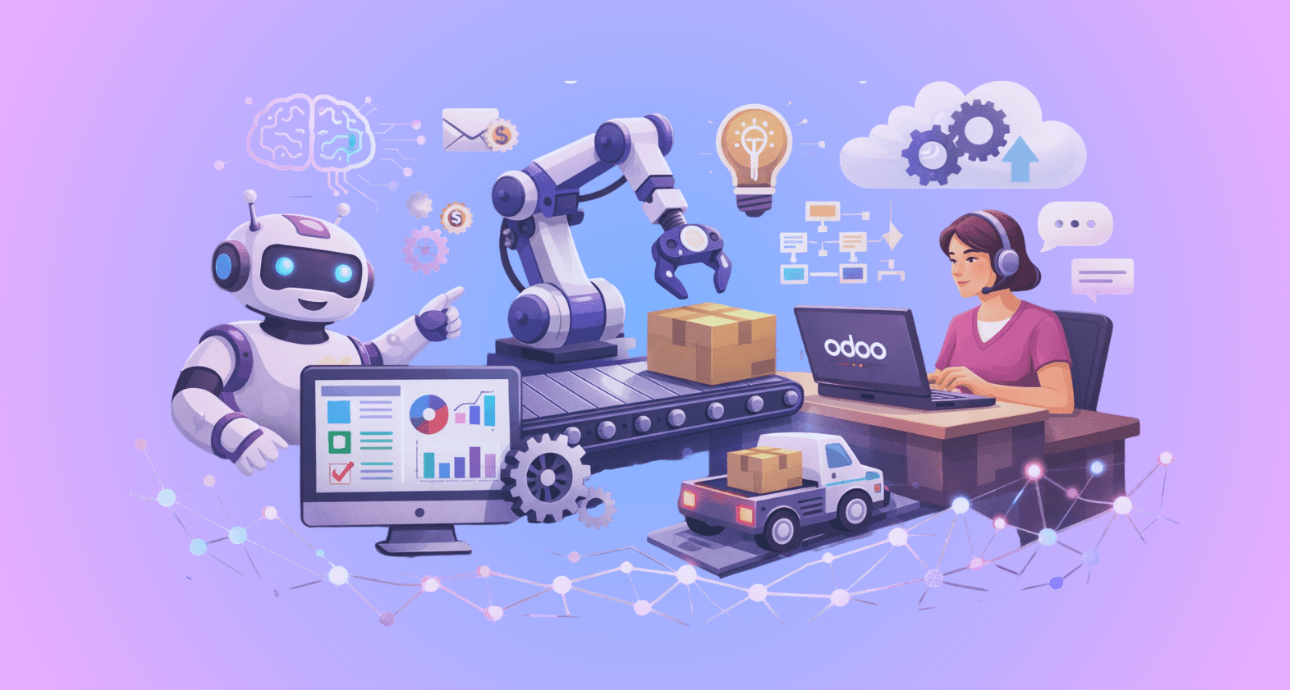
Artificial Intelligence in Odoo has shifted from theory to everyday practicality. It is no longer about replacing human roles but about streamlining operations, reducing manual involvement, accelerating workflows, and enabling better data-driven decisions. As Odoo evolves from version 17 to 19, its native features combined with external AI models like ChatGPT, Python-based ML engines, and rule-based automation allow businesses to operate with unmatched efficiency.
AI works best when paired with Odoo’s automation layer—turning insights into actions and actions into measurable business impact. This guide covers realistic AI use cases already being implemented by businesses worldwide and explains how these solutions work inside Odoo’s architecture.
1. ChatGPT Inside Odoo: Transforming Sales & Customer Support
AI for Sales Productivity in CRM & Sales Orders
Sales teams often spend excessive time writing quotations, explaining products to customers, drafting emails, and responding to repeated queries. When ChatGPT is embedded into Odoo’s Sales Order, CRM Lead, or Quotation interface, users receive instant AI-generated descriptions tailored to the customer’s industry, purchase patterns, and past communications.
For example, a sales executive preparing a quotation can simply click “Generate Quote Description,” after which the AI reads product details, customer history, industry type, and previous orders. It then generates a well-structured explanation such as: “This quotation includes premium logistics support with same-day dispatch and real-time tracking, specifically optimized for high-volume FMCG operations.” This not only speeds up quotation creation but also ensures every customer receives consistent and professional communication.
AI-Powered Helpdesk & Support
In customer support, most queries revolve around status checks, delays, or repetitive issues. AI embedded in Odoo Helpdesk can analyze ticket history, identify the context, and generate a ready-to-send response. When a customer submits a message such as “Where is my shipment?”, the AI checks the Delivery Order, reads the current tracking status, and drafts an accurate response based on real data. The agent simply reviews and sends it.
This drastically reduces response time and lowers the burden on support teams. As a result, customer satisfaction increases while operational costs decrease.
2. AI Sales Forecasting: Accurate Predictions for Planning
Forecasting traditionally depends on spreadsheets, manual assumptions, and guesswork. AI-driven forecasting in Odoo eliminates these inconsistencies by analyzing sales history, seasonal patterns, customer behavior, and product performance.
If the AI predicts next month’s revenue as ₹1.8 crore and highlights SKU-A and SKU-B as the most in-demand products, decision-makers receive a clear projection backed by historical data. It also identifies regions performing below expectations, enabling proactive planning and corrective actions. Businesses gain predictable revenue insights and can prepare better for demand fluctuations.
3. Intelligent Customer Segmentation with RFM AI Models
RFM (Recency, Frequency, Monetary) segmentation allows companies to categorize customers based on their buying habits. When AI performs this classification inside Odoo, it automatically identifies loyal customers, high-value buyers, at-risk clients, and inactive users.
Once customers are labeled, Odoo can trigger personalized campaigns, retention workflows, and targeted discount promotions. This creates a more relevant and engaging customer experience while reducing churn. Instead of marketers manually analyzing thousands of customers, AI completes the segmentation instantly and with greater accuracy.
4. AI Product Recommendations for Upselling & Cross-Selling
AI recommendation engines inside Odoo analyze product combinations, browsing patterns, and historical purchases. When a customer orders an industrial printer, the system may suggest ink cartridges, maintenance kits, or extended warranties directly on the sales order, eCommerce portal, or POS interface.
This not only improves customer experience but also increases the average order value significantly. Businesses leveraging this feature often see a notable rise in repeat purchases and upsell success.
5. AI Inventory & Demand Forecasting
Inventory mismanagement—either overstocking or stockouts—results in loss of profits. AI in Odoo provides precise stock predictions by learning from past sales, supplier timelines, product popularity, and seasonal variations.
If the system predicts that SKU-X will run out in twelve days, it automatically recommends the reorder quantity and alerts the inventory manager. This ensures uninterrupted operations, optimized inventory levels, and better cash flow management.
To explore advanced logistics and shipping apps, refer to:
https://apps.odoo.com/apps/modules/browse?search=vraja
6. AI in Accounting & Finance
Accounting teams often spend hours categorizing expenses, assigning accounts, and identifying tax rules. AI can read bill descriptions, detect vendor types, match historical entries, and categorize transactions instantly. This results in faster month-end closing and higher accuracy.
Additionally, AI can evaluate payment history and identify customers likely to delay payments. Odoo can automatically adjust credit limits or trigger follow-up reminders, helping businesses maintain healthier cash flow.
7. AI in Shipping & Logistics Automation
Logistics operations benefit significantly from AI, especially in selecting carriers. Instead of manually comparing rate charts and delivery expectations, AI evaluates cost, delivery performance, destination type, and history to choose the most efficient carrier automatically.
This leads to reduced freight expenses, faster deliveries, and improved customer satisfaction. Businesses that handle bulk shipments gain the highest advantage from AI-driven carrier intelligence.
8. AI-Enhanced Dashboards for Management
Odoo dashboards become far more valuable when AI converts raw data into meaningful insights. Executives can receive statements like: “Sales declined by 12% due to stock shortages in the northern warehouse,” or “Top customers contribute 68% of total revenue this quarter.” This eliminates the need for manual data interpretation and helps leaders respond strategically and quickly.
9. Technical Architecture: How AI Works Inside Odoo
AI in Odoo follows a structured data flow:
Odoo stores transactional data across models, which is passed to an AI service layer and processed through ChatGPT or machine learning engines. Once insights are generated, Odoo applies these outputs through its action system, automations, and scheduled jobs. This creates a seamless back-and-forth loop between human actions, AI analysis, and automated execution.
10. Why AI and Automation Must Work Together
AI alone can only analyze data and provide insights. The real transformation happens when Odoo automation uses those insights to perform actions. For example, when AI predicts a stock shortage, Odoo can automatically create a purchase order. This combination creates self-running processes with clear business ROI.
AI Use Cases in Odoo — Summary Table
| Area | AI Use Case | Impact |
| Sales | Automated Quote Writing | Faster Closure |
| CRM | Lead Scoring | Better Conversion |
| Marketing | RFM Segmentation | Improved Targeting |
| Inventory | Demand Prediction | Zero Stockouts |
| Accounting | Auto Classification | Faster Month-End |
| Logistics | Carrier Selection | Reduced Shipping Cost |
| Support | AI Ticket Replies | Faster Response |
Conclusion: AI in Odoo Is Already Transforming Businesses
AI is no longer experimental—it is practical, accessible, and highly efficient within Odoo. Organizations adopting AI-driven processes operate faster, improve decision-making, and scale without increasing workforce costs. By integrating AI with Odoo’s automation engine, businesses build intelligent systems that work independently and deliver measurable improvements.
How Vraja Technologies Helps You Implement AI in Odoo
Vraja Technologies specializes in Odoo AI integration, chatbot automation, forecasting engines, custom dashboard development, and advanced Odoo workflows. As an official Odoo Partner, we help businesses adopt AI responsibly and efficiently, ensuring smooth implementation and measurable results.